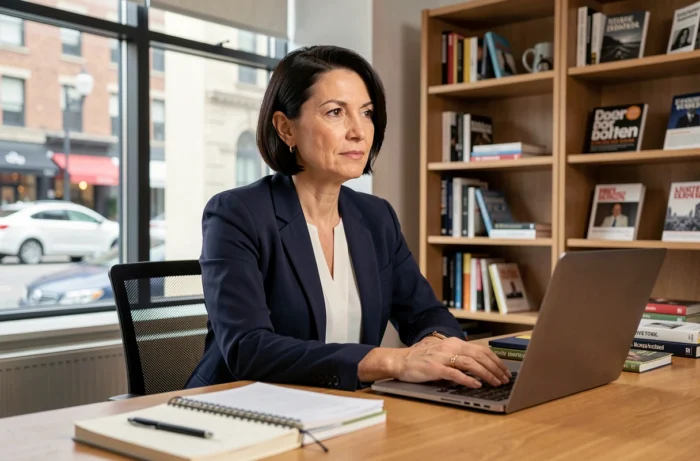
Carole Barjon is one of the most recognized political journalists in the French media landscape. She joined Nouvel Observateur in the early 1980s and has covered French politics for over three decades, serving as the political editor of L’Obs. Despite this prolonged exposure, her romantic life remains an almost total blind spot for anyone seeking reliable information.
Carole Barjon and Political Journalism: A Public Career, a Private Person
Carole Barjon’s professional trajectory is well documented. With degrees in law and journalism, she specialized early on in tracking the French right. Her investigations and works, such as Mais qui sont les assassins de l’école? published in 2016 or Le coup monté focused on the Copé-Fillon conflict, have ensured her constant visibility on television platforms, particularly on BFM TV.
This notoriety has not led to personal exposure. Press portraits, in-depth interviews, and biographical notices on sites like Gala or Voici focus on her editorial career and her positions. No reference interview addresses her romantic or family life. This observation is not an oversight: it reflects a deliberate choice to separate the professional sphere from the intimate sphere.
Several online articles attempt to shed light on Carole Barjon’s private life, but serious content systematically struggles with the absence of direct statements from the journalist on the subject.
Carole Barjon’s Relationship Status: What Available Sources Allow Us to Say
Some sites claim that Carole Barjon is married to Bruno Jeudy, a well-known political journalist as well. This information circulates on several pages, but it raises a simple methodological problem: no primary source confirms it. Neither a joint interview, nor a mention in a portrait signed by a reputable media outlet, nor a public statement from either party.
The pages that ask the question “Who is Carole Barjon’s husband?” repeat this association without ever citing their source. The pattern is recurrent in the celebrity treatment of media personalities: an unsourced piece of information is passed from site to site until it acquires the appearance of an established fact.
The available data does not allow us to conclude on her current marital status. The lack of confirmation does not mean that the information is false, but it prevents it from being presented as a verified fact.
Why Search Results Remain Unreliable on This Topic
The mechanics that fuel this content deserve to be understood. When a public figure does not communicate about their private life, an informational void is created. This void generates search queries (“Carole Barjon’s husband,” “Carole Barjon couple”), which in turn prompt sites to produce articles answering these questions, sometimes without tangible elements.
Celebrity biographies compile professional data and fill the rest with assumptions. This functioning is not unique to Carole Barjon. It affects most media figures who do not actively participate in staging their personal lives.
Discretion of Political Journalists in France: A Context to Consider
Carole Barjon’s restraint regarding her intimate life fits into a fairly widespread tradition among French political journalists. Covering the backstage of power implies maintaining a form of distance, including regarding one’s own media exposure.
Several factors explain this posture:
- The credibility of a political journalist partly relies on their ability to remain detached from personal news, so as not to become a subject themselves
- Daily interactions with political leaders require a clear boundary between the professional and the private, lest the necessary trust for investigative work be compromised
- The French legal framework strongly protects privacy, including that of public figures, which limits the publication of unsolicited information
This discretion contrasts with the treatment reserved for other media figures. Léa Salamé and Raphaël Glucksmann, for example, form a couple whose existence is publicly known and regularly commented on in the gossip press. Their situation fundamentally differs: both have, to varying degrees, accepted that this aspect of their lives be visible.
Carole Barjon: Between Professional Notoriety and Biographical Gray Area
The paradox is striking. Carole Barjon has a career long enough and visible enough for her professional biography to be solidly established. Her works are referenced, her television appearances archived, her investigations cited. In contrast, her personal biography remains a gray area that neither the press nor the interested parties have sought to clarify publicly.
This asymmetry raises a broader question about how the public consumes information related to media personalities. The expectation of total transparency, fueled by social networks and search engines, meets here a wall of voluntary silence.
For anyone seeking definitive answers about Carole Barjon’s romantic situation, the current state of public sources imposes a sober conclusion: verifiable elements are limited to her career, and everything else currently falls into the realm of unsubstantiated speculation.