
Emptying a home takes time, energy, and concrete choices about the destination of each item. Whether the context is a move, an inheritance, or a resale, the actual duration of the operation depends less on the area than on the chosen method and the available disposal channels. This article compares the main options, their timelines, and recent regulatory constraints to measure what truly speeds up – or slows down – the process.
Comparison of methods for emptying a home: timelines and constraints
The choice between self-sorting, an organized home clearance, and hiring a clearance company does not yield the same results in terms of speed. Here is a synthetic comparison.
| Method | Average observed time | Cost | Personal effort |
|---|---|---|---|
| Self-sorting and disposal | Several weeks | Low (transport, recycling center) | Very high |
| Home clearance | One to two weekends of sales, then disposal of the rest | Variable (advertising fees, handling) | High |
| Clearance company | Several days | Higher (quote based on volume) | Low |
| Combination of personal sorting + clearance for the rest | One to two weeks | Intermediate | Moderate |
The combined method – an initial personal sort followed by a professional service – often represents the best compromise between budget control and speed. It allows for the preservation of valuable or sentimental items before entrusting the bulk to a service provider.
To explore each solution for emptying on C Ma Déco, it is useful to cross-reference the estimated volume with the actual time you have available.
Regulatory obligations that change the game when emptying a home
Two recent developments are significantly changing the way to dispose of the contents of a home.
Source sorting of biowaste has been mandatory since January 2024. Closet leftovers, food scraps, and organic waste can no longer go into regular household trash. When emptying a kitchen or pantry, these waste types must be separated and directed to a dedicated collection bin or a voluntary drop-off point. Failing to do so may lead to difficulties with the co-ownership or the local waste manager.

Another point to check: the prior declaration at the town hall for a home clearance. Since May 2026, the declaration requirement has been removed for certain home sales. However, the annual limit on sales remains regulated. Organizing a home clearance without checking this limit can lead to a reclassification as a commercial activity.
These constraints extend the sorting duration if they are not anticipated from the start. Integrating them into the planning from day one avoids having to revisit already closed bags.
Reuse channels and free collection: unknown accelerators
Competitors often detail donations to associations or online sales. They rarely mention institutional channels that take care of certain bulky items for free.
- Free collection of large household appliances: eco-organisms collect refrigerators, washing machines, ovens at home, free of charge, provided a time slot is scheduled. This frees up a considerable volume without transport effort.
- Paris launched in July 2025 an experiment for reuse of used mattresses in several districts, indicating that other major cities may follow. A mattress is heavy and takes up space: being able to have it collected for free changes the logistics.
- Resource recovery centers and recycling centers accept furniture, dishes, books, and clothing in good condition. Their territorial network has densified in recent years, reducing transport distances.
Using these channels before the professional clearance reduces the billed volume, thus lowering the overall cost. The time savings are also real: a refrigerator taken out by an eco-organization means one less heavy handling to manage yourself.
Sequencing room by room: what slows down and what speeds up
All competitors recommend proceeding room by room. An analysis of feedback shows that certain rooms consistently take longer than expected.
The kitchen contains the greatest diversity of items: small appliances, dishes, groceries, cleaning products. Each category falls under a different disposal channel (biowaste, glass, bulky waste, hazardous waste). Planning for double the estimated time for this room avoids delaying the entire schedule.
In contrast, bedrooms empty faster when applying a binary sorting rule: the clothing has been worn in the last twelve months, or it goes. Hesitations about clothing represent one of the primary factors of slowdown. Reserving a limited time slot for this decision – and sticking to it – produces measurable results on the total duration.
The garage and cellar pose a different problem: items there are often heavy and difficult to access. Paint cans, oils, solvents fall under hazardous waste and require a drop-off at a recycling center. Mixing these items with the rest of the bulky waste creates additional sorting downstream.
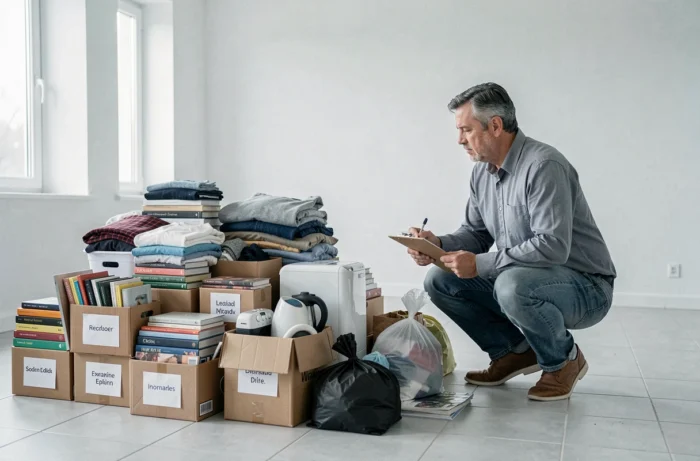
The most effective sequencing involves starting with storage spaces (cellar, attic, garage), then living areas, and finishing with the kitchen. This progression frees up buffer space from the first hours, which smooths the rest of the process.
A home emptied in less than two weeks relies on three levers: a schedule aligned with free collection time slots, sorting by channel from the first bag, and calling in a clearance service only for the residual volume. The final cost directly depends on the volume you have directed to the right channels before their intervention.