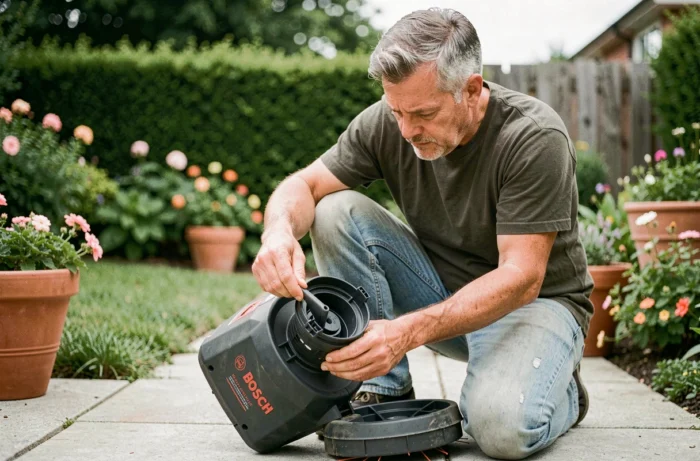
The spool system of Bosch trimmers relies on a semi-automatic feed mechanism that adjusts the length of the line at each start-up. This design simplifies regular use but requires a precise method when replacing the spool. A rough winding or poorly calibrated line can cause jams, repeated breakages, or uneven cutting.
Bosch Semi-Automatic Feed: What the Mechanism Requires for Spool Change
On recent models like the Bosch UniversalGrassCut 18V-26-500, the line automatically readjusts at start-up. A button on the spool also allows for manual adjustment of the desired length. This dual system (automatic and manual) means that the spool must be installed with a regular winding, or it will block the feed mechanism.
We recommend removing the battery before handling the spool. On a semi-automatic model, even the slightest contact with the start button can trigger rotation. This precaution also applies to corded models: always unplug the device.
The return spring located under the spool maintains the tension of the line during rotation. If this spring comes loose during disassembly, the line will not unwind correctly. Before removing the used spool, note the position of the spring and the retaining hook to replicate the assembly exactly.
Line and Spool Compatibility on Bosch Trimmers
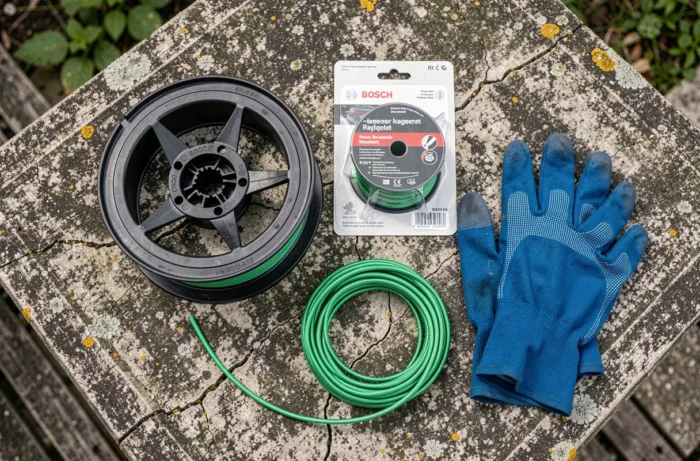
Not all nylon lines are suitable for all Bosch models. The diameter of the line directly affects cutting quality and the longevity of the spool. A line that is too thick strains the motor and prematurely wears out the drive. A line that is too thin breaks at the slightest contact with a concrete edge or a root.
To learn how to change the Bosch trimmer spool line by choosing the correct diameter, check the exact reference of your device on the casing or in the manual. Bosch indicates the compatible diameter directly on the cover of the cutting head.
Another technical point not to overlook: Bosch strictly separates its ranges. Accessories from the green range (Home and Garden) are not interchangeable with those from the blue range (Professional). A spool designed for an ART model cannot be mounted on a Professional series model, even if the dimensions seem close. Check compatibility by reference, not by appearance.
Criteria for Selecting Replacement Line
- The exact diameter recommended by Bosch for your model (noted on the spool cover or in the manual)
- The section of the line: round for regular use on soft grass, star-shaped or square for tougher grasses and dense edges
- The length of line to be wound on the spool, which must not exceed the indicated capacity to avoid blocking rotation
- Range compatibility: Home and Garden (green) or Professional (blue) reference, never interchangeable
Bosch Spool Replacement Procedure: Winding and Reassembly
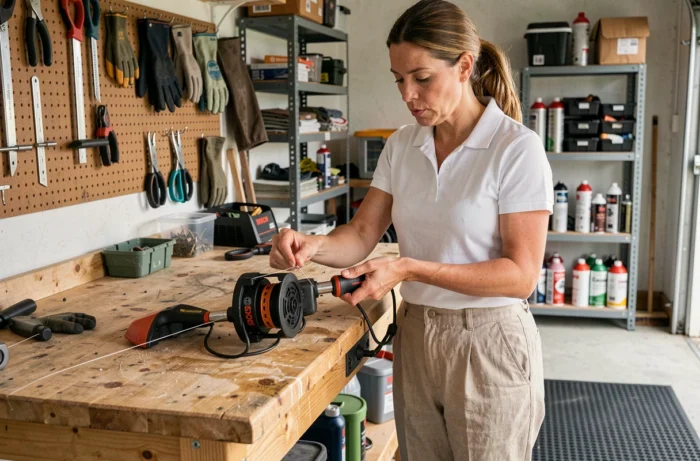
The majority of errors occur during winding. A poorly tensioned line creates overlaps that block the exit during automatic feed. We observe that the main cause of premature line breakage is irregular winding, with coils crossing inside the spool.
Winding and Reassembly Steps
- Remove the cover of the cutting head by pressing on the side tabs (or unscrewing depending on the model). Take out the empty spool
- Insert the end of the new line into the retaining notch on the spool. Wind in the direction indicated by the engraved arrow on the spool, maintaining constant tension
- Leave a sufficient length of line protruding through the exit hole. Replace the spool in the casing, ensuring that the return spring is in position
- Put the cover back on, snap the locking clips, then gently pull on the line to check that it unwinds without resistance
- Reconnect the battery or plug in the device, then perform a short start to confirm that the semi-automatic feed works
The winding direction is the most common source of error. A line wound the wrong way will jam at the first use. The arrow molded on the spool always indicates the correct direction.
Diagnosis of Common Failures After Bosch Spool Replacement
If the line no longer feeds after replacement, the problem almost always comes from a winding that is too tight or overlapping coils. Disassemble the spool, completely unwind the line, and start again with consistent tension, without forcing.
A line that consistently breaks at start-up indicates an unsuitable diameter or a line of poor quality. Cheap generic nylon lines have a significantly lower tensile strength than branded lines. On a Bosch device with semi-automatic feed, this difference in strength is directly felt.
The spool cover popping off during use indicates that the locking clips are not properly engaged, or that the cover itself is worn. Check the condition of the locking tabs with each spool change. If they are cracked, replace the cover before reusing the device.
A deformed return spring causes erratic line unwinding. This spring is a wear part that is often overlooked. If the line comes out in jerks or in excess, inspect the spring before blaming the spool itself.
One last technical point: on Bosch models compatible with the Power for All alliance, the battery can be shared with Gloria, Gardena, or Husqvarna devices. However, the spool and cutting head remain strictly specific to each Bosch model. Battery sharing does not extend to cutting consumables.