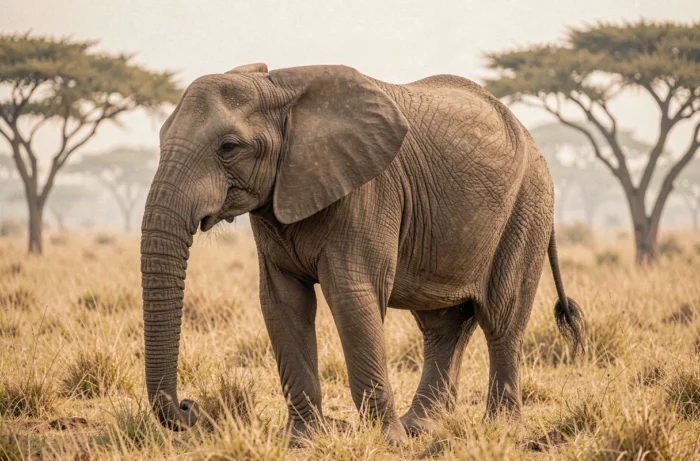
Inter-species behaviors in primates, tool-assisted hunting strategies in cetaceans, or the massive return of baleen whales in Greenland waters illustrate an animal map that is much more complex than the usual compilations of “unusual facts.” Here, we focus on three underexplored areas in mainstream content: inter-species social relationships, tool use in marine environments, and the dynamics of recolonization among large marine mammals.
Primates and inter-species adoption: an underestimated social behavior
Monkeys sometimes adopt other animals. This phenomenon, documented in a global dataset covering up to 2025, is more frequent than previously thought.
The analysis synthesized by Futura-Sciences shows that these interactions mainly occur when primates have free time and are relatively protected from predators. This is described as a form of “social leisure” directed towards other species, a concept that challenges the purely utilitarian view of interspecific relationships.
This finding calls into question the traditional framework of obligatory mutualism. Here, no direct nutritional or defensive benefit is identified. Primates seem to seek social stimulation, which brings these behaviors closer to what we observe in domestic mammals placed in enriched environments. To delve deeper into these species portraits and their behavioral peculiarities, the animals featured on Animal Time provide a complementary overview covering mammals, insects, and wild species.
The implications of this research go beyond mere anecdotes. It questions the very notion of social cognition in non-human primates and opens a research field on non-adaptive motivations in the animal kingdom.
Dolphins and shells: hunting tools in marine environments
Some dolphins use shells as fish traps. Filmed observations, reported by several scientific media, show cetaceans deliberately trapping prey in empty shells before bringing them to the surface to consume.
This behavior is not a simple feeding reflex. We are faced with a multi-step operational chain:
- Identifying an appropriately sized empty shell on the seabed
- Orienting the shell to trap a fleeing fish
- Rising to the surface and flipping the shell to extract the prey
This sequence implies planning, a spatial representation of the tool, and cultural transmission within the group. Researchers who filmed these scenes emphasize that only certain individuals within a population master this technique, suggesting social learning rather than a generalized instinct.
In marine ethology, the notion of tool use had long been confined to sea otters (which use stones to break shells). Dolphins add a layer of complexity: the tool is not a striker, but a container, which implies a different functional understanding.
Baleen whales in Greenland waters: recolonization and massive aggregations
A study published in Frontiers in Marine Science in 2026 documents a spectacular increase in the presence of baleen whales in Greenland waters between 1987 and 2025. Common rorquals, humpback whales, and minke whales now form large feeding aggregations mixing several species in areas where their presence was historically rare.
In 2024, researchers reported collective “hunting frenzies” involving several thousand individuals. This phenomenon raises concrete ecological questions: is the biomass of prey (krill, small pelagic fish) sufficient to sustain these densities in the long term?
Factors of recolonization
Several hypotheses converge. The reduction of whaling pressure since international moratoriums has allowed for demographic recovery over several decades. The warming of Arctic waters is altering the distribution of krill, concentrating resources in previously marginal areas.
The Greenland Sea is becoming a hotspot of marine biodiversity, with direct implications for the management of local fisheries. Multi-species aggregations create unprecedented food competition between cetaceans and human fishing activities.
Animal species and atypical behaviors: what science analyzes
Beyond these three cases, recent research highlights behaviors long considered aberrant. Science et Vie reports that devouring one’s young may paradoxically be a strategy to ensure the survival of the lineage in certain species. Filial cannibalism, observed in fish, rodents, and some insects, optimizes the allocation of parental resources when environmental conditions deteriorate.
Another rarely addressed angle: the discovery of mummified cheetahs at the bottom of nearly inaccessible caves, documented by Science et Vie. These specimens, preserved for centuries, provide paleogenetic data on the past genetic diversity of the species, at a time when the global cheetah population is experiencing a concerning genetic bottleneck.
- Inter-species adoption in primates: non-utilitarian social behavior, globally documented
- Use of container tools in dolphins: cultural learning, not instinct
- Recolonization of the Greenland Sea by baleen whales: ongoing multi-species dynamics
- Filial cannibalism: adaptive strategy, not behavioral pathology
- Mummified cheetahs: paleogenetic archives for modern conservation
These five axes share a common point: they contradict simplistic readings of animal behavior. Nature is neither reduced to raw competition nor idealized cooperation. Each species develops calibrated responses to its environment, and it is precisely this granularity that contemporary research is beginning to document rigorously.