
In front of a row of televisions, acronyms accumulate. ULED, QLED, OLED, Mini-LED: it’s hard to know what each label hides. The problem is that ULED and QLED refer to two different approaches to the same technical principle, enhanced LED backlighting, but are carried by two competing brands. Understanding what truly separates them helps avoid paying a premium for an invisible image gain in your living room.
Quantum Dots vs. optimized backlighting: what each acronym really means
Have you ever noticed that the colors of a television in a store always seem more vibrant than at home? This is largely due to the type of backlighting used. A standard LCD screen lights its pixels from behind with white LEDs. The light then passes through color filters to produce the image.
The QLED adds a layer of Quantum Dots between the LEDs and the LCD panel. These nanoparticles convert blue light into very pure red and green. The result: a wider color spectrum and significantly higher brightness than a standard LCD. Samsung popularized this term and remains the main manufacturer using it.
The ULED, on the other hand, is a commercial name created by Hisense. It does not rely on a unique technology but on a combination of processes: advanced local dimming, software image processing, and, in some models, Quantum Dots. In practice, a high-end ULED television can incorporate the same quantum dots as a QLED.
Before comparing ULED and QLED televisions solely based on the acronym, it is essential to look at the technical specifications model by model. The commercial name does not guarantee a specific level of performance.
Brightness and contrast in the living room: the criterion that distinguishes ULED and QLED
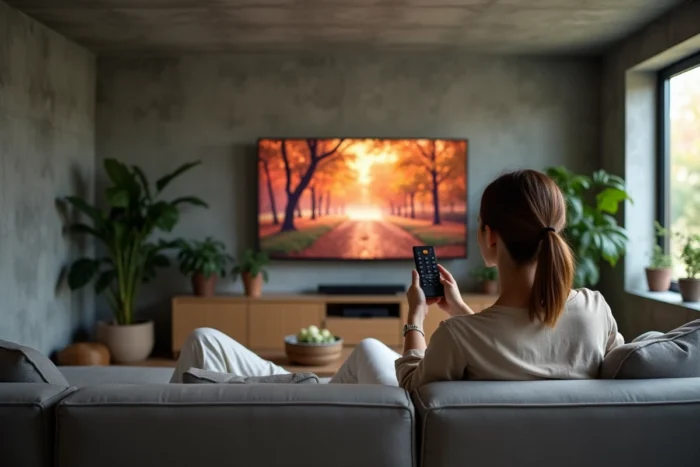
Brightness is the most tangible parameter in daily use. A very bright television remains readable in front of a large window during the day. A less powerful model offers better comfort in the evening but disappoints in a south-facing room.
Samsung’s QLEDs generally display high brightness, enhanced by the layer of Quantum Dots that amplifies the light output of the LEDs. This is a measurable advantage for HDR content, where light peaks make reflections and explosions more realistic.
Hisense’s ULEDs focus more on local dimming to deepen blacks. On models with numerous backlighting zones, some LEDs turn off completely while others remain on. The perceived contrast increases, even if the maximum brightness remains a notch below that of high-end QLEDs.
The arrival of anti-reflective panels changes the game
In 2025-2026, a long-neglected criterion gains importance: “glare-free” or Glare Free panel treatments. Several manufacturers, led by Samsung on its Neo QLEDs, incorporate coatings that drastically reduce reflections. For a very bright living room, this treatment can be as important as the raw brightness of the panel.
Hisense also offers anti-reflective panels on some recent ULEDs, but the range coverage remains less extensive. Checking for the presence of this treatment in the product sheet has become a useful reflex.
Energy label and consumption: an often-overlooked angle
Since March 2021, televisions have been subject to the new European energy label A-G, without the old classes A+, A++, or A+++. This rescaling has shifted the majority of televisions to classes C or D. Classes A and B remain rare in 2026, even among premium models.
Why does this point matter in the choice between ULED and QLED? Because consumption varies significantly depending on the number of backlighting zones, maximum brightness, and HDR processing. A very bright QLED logically consumes more than a similarly sized ULED set to moderate brightness. The energy label, expressed in kWh for 1,000 hours in SDR and HDR modes, allows for an objective comparison of two models.
Choosing based on your actual usage: movies, sports, or gaming
The most recent guides recommend reasoning by usage scenario rather than by technology. Here are the cases where each family stands out:
- Movies in a dark room: a ULED with many local dimming zones offers deep blacks and convincing contrast, often at a lower budget than an equivalent QLED.
- Sports and very bright rooms: a QLED (or Neo QLED with Mini-LED) takes advantage of its high brightness and, on recent models, its anti-reflective panel to maintain a readable image even with open windows.
- Gaming: response time, refresh rate (minimum 120 Hz), and VRR compatibility matter more than the type of backlighting. Both ranges offer suitable models, but these specs need to be checked individually.
Before buying, ask yourself a simple question: in what lighting do you most often watch television? The answer guides you towards the right family of panels.
ULED or QLED: the points to check before purchase
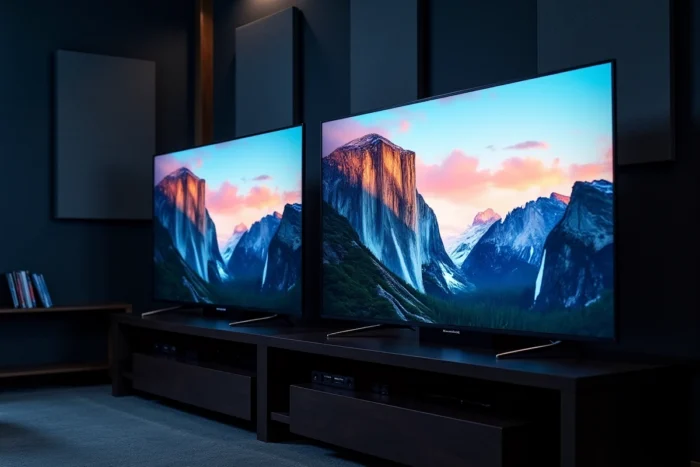
Beyond the acronym, several concrete elements deserve your attention on the technical sheet:
- Number of local dimming zones: the more there are, the better the contrast. A model with a few dozen zones cannot compete with a model with several hundred.
- Actual presence of Quantum Dots: some entry-level ULEDs do not incorporate them, which reduces the volume of colors displayed.
- Energy class in HDR mode: this is the most power-hungry mode, and the gap between two models can be significant.
- Anti-reflective treatment: at equal brightness, a Glare Free panel improves comfort much more than an excess of nits.
ULED and QLED are two marketing labels for a common technical base, LED-backlit LCD. The difference lies model by model, not acronym against acronym. Reading the complete technical sheet, checking the energy class, and testing the screen in conditions close to your living room remains the most reliable method to make a choice you won’t regret six months later.