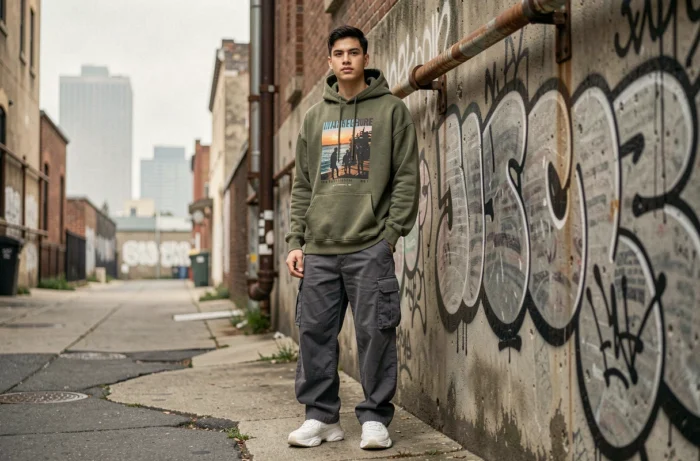
Streetwear refers to a wardrobe born from skate, hip-hop, and sportswear culture, which has gradually integrated into everyday closets well beyond its original circles. In 2026, streetwear trends are no longer limited to flashy logos or collector sneakers. The movement absorbs tailoring codes, technical materials, and more subdued palettes, redefining the urban look.
Technical streetwear: when outdoor materials enter the city
The boundary between urban clothing and outdoor gear has largely faded. Recent streetwear collections incorporate water-repellent fabrics, windproof cuts, and lightweight insulation, designed for changing weather conditions.
This approach is based on a simple principle: the layering of lightweight yet protective layers. A technical windbreaker worn over a thick cotton hoodie, a quilted sleeveless jacket slipped under a bomber, a water-repellent overshirt as a third layer. The goal is not to look like a hiker but to combine functionality with an urban silhouette.
International streetwear labels like thisisneverthat are already structuring their autumn 2026 collections around this modular logic. Pieces can be worn alone in mild weather or layered when temperatures drop, without sacrificing the overall look.
Technical materials also provide a practical advantage that cotton alone cannot offer: garments that withstand a downpour without looking like a raincoat. This intersection of textile performance and street aesthetics defines current technical streetwear. The pieces offered on urban-fashion.fr illustrate this evolution towards an urban wardrobe that no longer fears the rain.
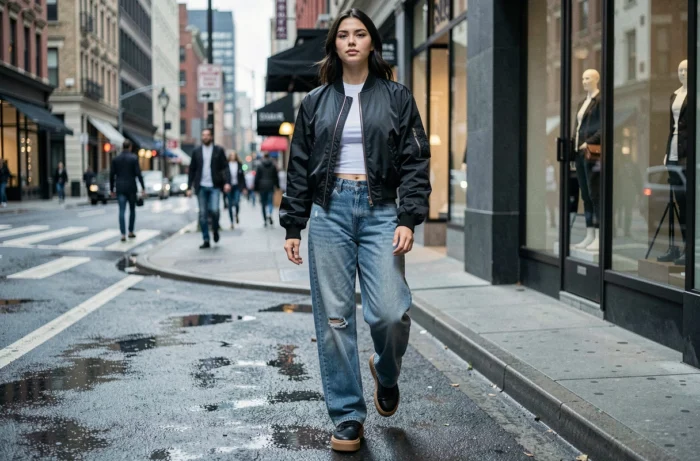
Casual tailoring and subdued palette: polished streetwear
The street style observed during the 2026 Fashion Weeks in London and Milan confirms a clear shift. Pure sportswear streetwear is receding in favor of a more refined style, which fashion media refer to as polished streetwear.
In practical terms, this translates into combinations that would have seemed contradictory a few years ago: a sharply tailored blazer worn with cargo pants, dark denim paired with polished sneakers, a structured jacket thrown over an oversized t-shirt. The result oscillates between relaxed and sophisticated.
Colors that ground the silhouette
The dominant palette abandons bright hues in favor of more muted tones. Chocolate, navy, anthracite, cream: these colors serve as a stable foundation on which each piece finds its place without shouting.
This chromatic choice is not trivial. A subdued palette allows for mixing streetwear and dressier pieces without visual disruption. Wearing an anthracite hoodie under a cream overcoat does not produce the same effect as a neon green hoodie under the same coat.
Accessories follow the same logic. Structured bags replace sporty fanny packs, and sleek-cased watches take precedence over silicone bracelets. Accessories become a punctuation element of the look, not a billboard.
Camouflage print and visual codes of the 90s
Among the patterns making a strong comeback, camouflage holds a special place. Identified by several European fashion media as a key visual code of current streetwear, it is no longer worn in a total military look. Contemporary use isolates it to a single piece (jacket, pants, or cap) and pairs it with solid basics.
This resurgence is part of a broader return of visual codes from the 90s. Loose cuts, discreet logos positioned as embroidery rather than giant screen prints, faded jeans worn low or mid-rise: the wardrobe draws from this decade without copying it literally.
- Camouflage works better as a single piece, contrasted by black or white, than diluted across the entire outfit
- Oversized cuts inherited from the 90s gain structure through slightly defined shoulders, far from the shapeless fall
- Chunky sneakers, another 90s legacy, remain present but in monochrome colors that fit into the subdued palettes described above
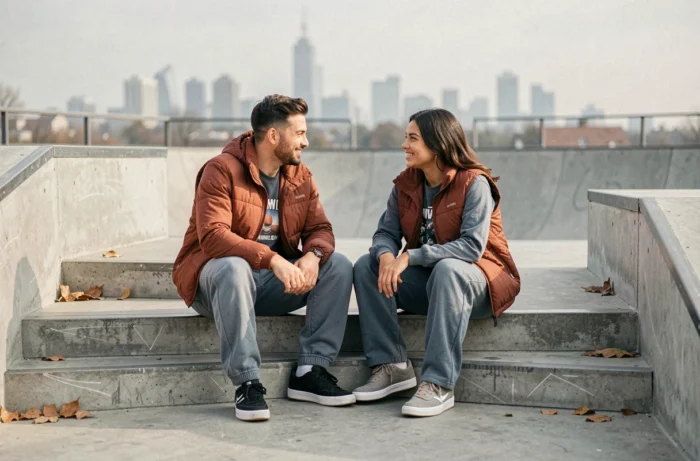
Anti-fast fashion law in France: a direct impact on the streetwear wardrobe
Since the implementation of the anti-fast fashion law in France, ultra-fast fashion platforms are subject to an environmental tax. This measure is gradually changing purchasing habits in the streetwear segment, traditionally fueled by frequent drops at low prices.
The textile environmental display, scheduled for October 2026, will make the ecological cost of each garment visible. For the streetwear consumer, this means that the displayed price of a t-shirt or hoodie will soon include a readable environmental component.
This regulatory context encourages less frequent but more thoughtful purchases. Investing in a durable technical jacket rather than three disposable polyester bombers becomes as much an economic calculation as an aesthetic one.
- Favor pieces made from durable materials (heavy canvas, ripstop nylon, brushed cotton) that withstand repeated washes
- Check the origin and traceability, facilitated by ongoing European obligations
- Consider the second-hand market for vintage streetwear pieces, where authentic 90s cuts can be found at reasonable prices
Streetwear in 2026 is built on a balance between technical materials, silhouettes borrowed from tailoring, and contained palettes. French regulations on fast fashion accelerate this transformation towards more sustainable wardrobes. The stylish urban look no longer relies on the accumulation of pieces but on the precision of each choice, from fabric to cut to color.