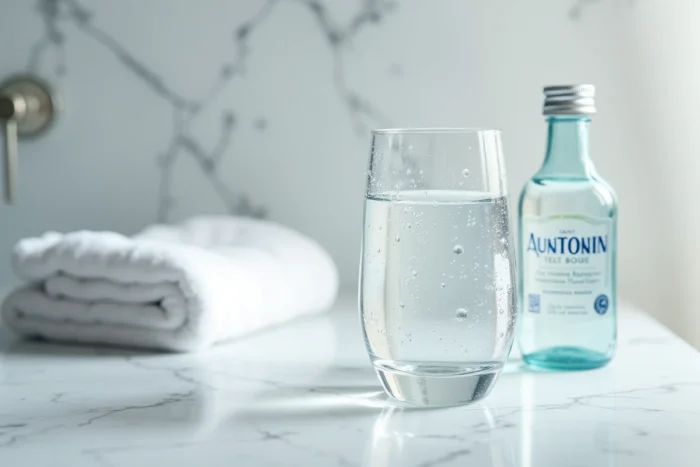
Saint Antonin water, bottled in Tarn-et-Garonne, frequently comes up in discussions about intestinal transit. Presented as a natural mineral water with a moderate magnesium profile, it is generating increasing interest among people suffering from functional constipation. The available data on its actual effectiveness deserves a more rigorous examination than the simple feedback published on forums.
Magnesium and sulfates in Saint Antonin water: a limited laxative mechanism
The principle often put forward to explain the action of this water on transit is based on its magnesium and sulfate content. These two minerals, when they reach the colon without being fully absorbed, exert an osmotic effect: they draw water into the intestinal lumen, which softens stools and facilitates their passage.
The issue lies in the intensity of this effect. Saint Antonin water has a moderate magnesium content, significantly lower than that of waters like Hépar or Rozana, for which more solid data exist. Several consumers documenting the side effects of Saint Antonin water report a gradual effect, sometimes noticeable only after several weeks of regular consumption.
This mineral profile positions it more as a gentle osmotic laxative, suitable for mild and functional constipation. For severe or chronic complicated forms, the field data do not allow for a conclusion of sufficient effectiveness.

No published clinical studies on Saint Antonin water and constipation
This is the central point that most of the available online content sidesteps or ignores. To date, no published clinical trial has directly evaluated the effect of Saint Antonin water on constipation. No randomized trial, no control group, no publication in a peer-reviewed journal specifically addressing this water.
This observation does not mean that the water is ineffective. It means that claims about its digestive benefits rely exclusively on individual experiences and on extrapolation from the known mechanism of magnesium. In contrast, some competing magnesium-rich waters have clinical trials documenting their impact on stool frequency and consistency.
The absence of a health claim on the label of Saint Antonin water directly reflects this situation. The status of natural mineral water guarantees a stable composition and a protected source, but it does not allow the brand to claim a therapeutic effect on transit without validated evidence.
Consumer reviews on Saint Antonin water: what field feedback reveals
Online testimonials fall into two fairly distinct categories. On one side, satisfied users describe a gradual improvement in their transit after prolonged daily consumption. On the other, consumers who observe no notable change, sometimes after several weeks.
Positive feedback most often mentions:
- A noticeable softening of stools after two to three weeks of regular consumption, generally one to two glasses per day
- A taste considered neutral and a lightness in the mouth that facilitates long-term consumption, compared to more mineralized waters with a strong taste
- A good digestive tolerance, with few reported bloating compared to some waters very high in sulfates
Critiques focus on recurring points:
- A price perceived as high given the uncertain effectiveness, especially compared to Hépar or Mont Roucous
- Limited availability in certain stores, complicating regular consumption
- Insufficient results reported by people suffering from long-standing constipation
Field feedback diverges on one specific point: the regularity of consumption matters more than the daily volume. Drinking a liter occasionally produces less effect than moderate but consistent consumption over several weeks.
Reported side effects
The adverse effects mentioned by consumers remain rare and mild. A few cases of overly soft stools or slight abdominal cramps appear in the feedback, generally among those who started with a high consumption without progression. No serious side effects have been reported in the available sources.
Individuals on medical treatment, particularly those taking medications containing magnesium, should remain vigilant regarding the risk of magnesium overdose, which can cause diarrhea.
Saint Antonin water vs Hépar for transit: comparison based on facts
The comparison consistently arises in consumer searches. Hépar has a significantly higher concentration of magnesium and sulfates than Saint Antonin water. This difference in mineralization results in a quicker and more pronounced laxative effect with Hépar, but also a more pronounced taste that some consumers find difficult to tolerate daily.
Saint Antonin water positions itself in a different niche: that of a common drinking water, drinkable without taste effort, with a modest digestive effect but compatible with prolonged use. For someone whose constipation is mild and related to insufficient hydration, this profile may suffice. For more pronounced functional constipation, the data tend to point towards waters with higher mineralization.
The choice between these two waters thus depends on the degree of constipation, taste tolerance, and the ability to maintain a regular consumption over several weeks. Neither replaces medical advice in cases of persistent constipation or accompanied by unusual symptoms.
Saint Antonin water remains a reasonable option to support sluggish transit as part of daily hydration. Expecting it to have an effect comparable to a laxative, even a gentle one, may lead to disappointment. The context in which it can help is narrow: mild constipation, constant consumption, and calibrated expectations regarding what a moderately mineralized water can actually produce.