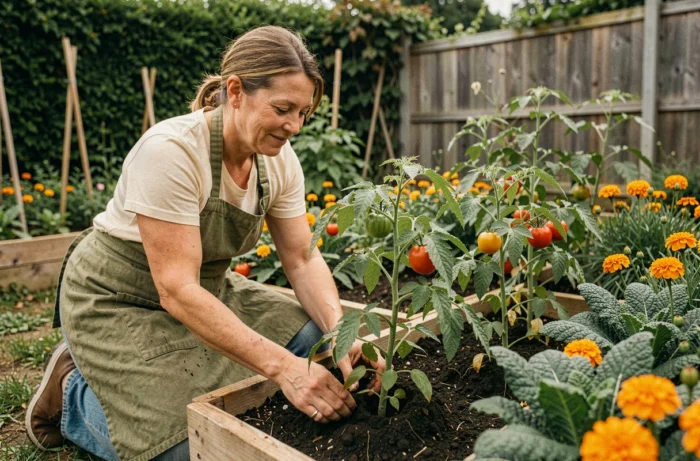
A successful organic vegetable garden relies less on the accumulation of isolated actions and more on the coherence between the soil, the plant layer, and the associated fauna. Succeeding in an organic garden while preserving biodiversity requires thinking in systems, not in a list of best practices.
Host plants for larvae: the blind spot of the organic garden
Most content on biodiversity in the garden focuses on flowering plants to attract adult pollinators. We observe that this approach overlooks a critical link: the host plants for the larval stages of insects.
Butterflies and moths do not lay eggs on just any plant. Each species depends on one or more specific host plants for its caterpillars. Without these plants, adults visit the garden without reproducing, and the local population does not sustain itself.
In the vegetable garden, this translates into concrete choices. Allowing a few carrot or fennel plants to go to seed provides support for hoverfly larvae, whose adults are formidable allies against aphids. Integrating nettles at the edges, often pulled out by reflex, nourishes the caterpillars of several species of fritillaries. Additional resources on these associations are detailed on jardinage-bio.com, which documents these interactions between plants and insects.
We recommend mapping the borders and uncultivated areas of the vegetable garden to intentionally install these host plants. This is not disorder; it is ecological infrastructure.
Living soil and invisible biodiversity: the foundation of the organic garden
A biologically active soil conditions everything else. The fertility of an organic vegetable garden is not managed solely through the addition of compost or manure. It depends on the diversity and activity of soil organisms: bacteria, mycorrhizal fungi, earthworms, springtails.
Three structuring practices help preserve this underground life:
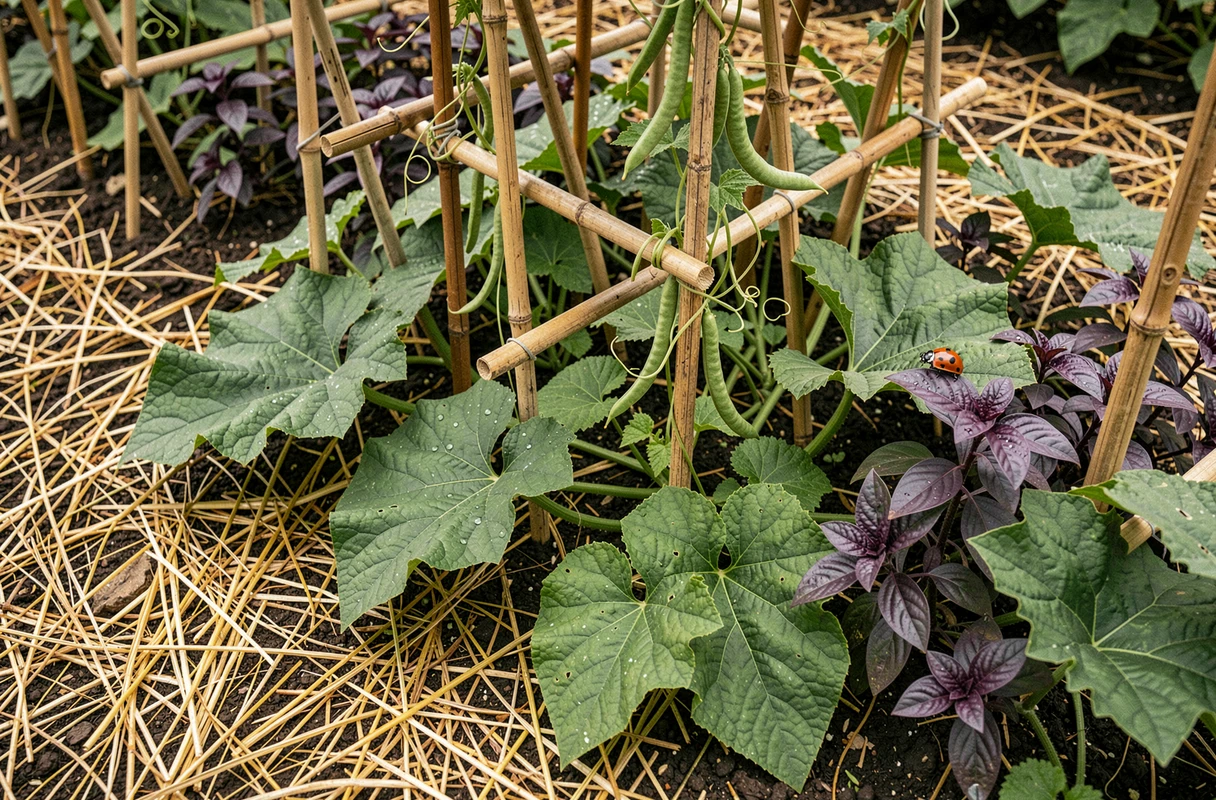
- Permanent mulching with diverse materials (dead leaves, ramial wood chips, straw) maintains moisture, regulates temperature, and continuously feeds the soil fauna.
- Reducing mechanical soil work limits the destruction of fungal networks. A soil turned with a spade loses mycorrhizal connections that took months to form in just a few minutes.
- Crop rotation over several seasons prevents selective depletion of the microflora. Alternating legumes, solanaceous plants, and crucifers stimulates different microbial communities with each cycle.
A permanently covered soil harbors more life than bare soil, even if fertile. Mulching is not a comfort accessory: it is the primary lever for biodiversity in the vegetable garden.
Plant layers and perennials in the garden: going beyond annuals
A classic vegetable garden contains only annual plants. This scheme depletes biodiversity because it resets the counters every season. Insects, birds, and associated microorganisms lose their habitat with each uprooting.
Integrating perennial plants transforms the dynamics. Fruit shrubs (blackcurrant, redcurrant), perennial herbs (thyme, rosemary, common sage), and climbers like vines or hops create vertical layers. These layers provide food and shelter year-round, including in winter when the annual vegetable garden is empty.
The interest goes beyond fauna. The deep roots of perennials structure the soil, bring up minerals, and serve as a relay for mycorrhizal networks. A row of comfrey at the edge of a bed, for example, attracts bumblebees early in the season while producing a potassium-rich liquid manure for neighboring crops.
Differentiated mowing and refuge zones
If the vegetable garden adjoins a lawn, the management of that lawn heavily impacts overall biodiversity. Mowing less frequently, or only certain strips while allowing others to flower, increases the availability of nectar and pollen for pollinators.
This approach of differentiated mowing requires no investment or special skills. It simply involves defining short mowed paths for circulation and allowing the rest to evolve freely for several weeks. Flowering grasses, clovers, and dandelions that appear nourish a much broader fauna than a closely mowed lawn.
Sowing and varieties: choosing for resilience, not just yield
The choice of seeds determines the organic vegetable garden’s ability to withstand climatic and health-related fluctuations. Heirloom varieties and populations (non-F1 hybrids) exhibit internal genetic variability that makes them more adaptable to a given terroir.
We recommend prioritizing seeds from participatory breeding or regional conservatories. These varieties, selected under organic conditions, respond better to local pressures (fungal diseases, summer drought) than lines optimized for input-based cultivation.
Mixing varieties within the same bed reduces pest pressure. Three varieties of tomatoes with complementary resistances, planted alternately, slow the spread of blight much more effectively than a single variety, even if resistant.
For leafy vegetables, allowing a few plants to go to seed attracts floral auxiliaries and allows for local reseeding. This sowing-harvesting-reseeding cycle empowers the garden and strengthens its genetic diversity season after season.
An organic vegetable garden that preserves biodiversity is not built by adding techniques. It is built through coherence between protected soil, diversified plant layers, and an assumed tolerance towards the fauna that settles there. Yield follows because the ecosystem works.