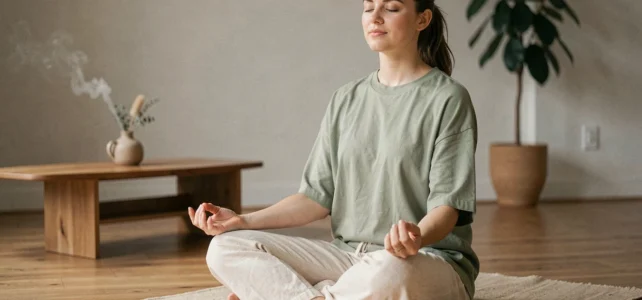
Chronic stress affects an increasing portion of the workforce, with documented repercussions on sleep, digestion, and the immune system. In light of this reality, non-pharmacological approaches are gaining traction. Their effectiveness varies depending on practices, protocols, and individual profiles. Some now benefit from solid scientific data, while others remain at the empirical stage.
High-Intensity Yoga and Sleep: What Recent Research Reveals
The style of yoga practiced and the frequency of sessions directly influence sleep outcomes. A recent meta-analysis shows that high-intensity yoga significantly improves sleep quality compared to walking, aerobic exercises, qi gong, or tai chi.
The protocol that emerges as the most effective is based on two weekly sessions of 30 minutes for 8 to 10 weeks. This precise framework (intensity, duration, frequency) allows for a measurable program, moving beyond the vague advice of “doing yoga.”
This distinction between gentle yoga and intense yoga changes the game for individuals whose stress primarily manifests as sleep disturbances. A practice that is too light may not be sufficient to activate the recovery mechanisms of the parasympathetic nervous system. Specialized resources like wikirelax.eu allow for the exploration of different relaxation approaches to identify the one that fits one’s profile.
Yoga Nidra and Cortisol: Measured Effects on Physiological Stress
Yoga nidra, sometimes referred to as “yogic sleep,” is practiced lying down and relies on voice-guided relaxation. It differs from other forms of yoga by the absence of physical postures.
A meta-analysis published in the Annals of the New York Academy of Sciences compiled 73 studies involving 5,201 adults. The results show that yoga nidra is associated with significant reductions in stress and anxiety compared to active comparators, not just the absence of treatment.
A study published in the National Medical Journal of India highlighted a significant decrease in salivary cortisol after yoga nidra sessions, accompanied by an improvement in deep sleep (stages N2 and N3) as measured by polysomnography. This biological data goes beyond the simple subjective feeling of relaxation.
Limitations to Consider
The available data do not allow for conclusions about the duration of effects once practice is interrupted. Most studies measure benefits during or just after a structured program. The question of the persistence of results in the long term remains open.
Adaptogenic Plants and Anxiety: Between Tradition and Partial Evidence
Anti-stress phytotherapy relies on several regularly cited plants: rhodiola, ashwagandha, passionflower, valerian. Their supposed common point is a regulatory action on the body’s response to stress via the hypothalamic-pituitary-adrenal axis.
However, the levels of evidence vary significantly from one plant to another. Here are the criteria to check before choosing a herbal supplement:
- The type of extract used (active ingredient titration), as a simple grind of dry plant does not have the same concentration as a standardized extract
- The duration of use studied in available trials, often limited to a few weeks
- Potential interactions with other substances, particularly antidepressants or anxiolytics
- The origin and traceability of the product, as dietary supplements are not subject to the same controls as medications
Individual responses vary widely: some people report a noticeable effect within a few days, while others see nothing after several weeks. The placebo effect remains difficult to isolate in studies on anti-stress phytotherapy, complicating the interpretation of results.
Controlled Breathing and the Autonomic Nervous System Response
Among natural anti-stress methods, breathing techniques offer a practical advantage: they cost nothing, require no equipment, and can be practiced anywhere. Heart coherence (inhaling for 5 seconds, exhaling for 5 seconds, for 5 minutes) is the most well-known.
Its mechanism of action involves stimulating the vagus nerve, which activates the parasympathetic nervous system and slows the heart rate. The effect is measurable in real-time on heart rate variability.
Pranayama: More Specific Breathing Techniques
Pranayama encompasses several breathing exercises derived from yoga. Some forms, such as bhramari pranayama (bee breath), are the subject of clinical trials to assess their impact on sleep quality and emotional balance.
These practices require guided learning to avoid hyperventilation, especially in individuals prone to panic attacks. A poorly conducted protocol can temporarily worsen anxiety instead of reducing it.
- Start with short sessions (3 to 5 minutes) to assess tolerance
- Favor long exhalations, which activate the parasympathetic brake more than deep inhalations
- Avoid prolonged breath holds without supervision, especially in cases of cardiac history
Daily stress cannot be resolved by a single method applied mechanically. Recent data show that intensity, regularity, and suitability to the individual profile matter more than the choice of a particular technique. A consistent practice of yoga nidra three times a week will yield more tangible results than a disordered alternation between ten different approaches.