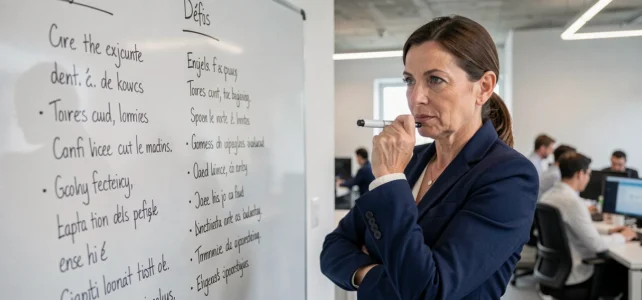
A manager receives two requests on the same Monday morning. The first: to adjust the team’s schedule to accommodate a peak in activity. The second: to ensure that this peak does not degrade the quality of service on which the renewal of a client contract depends. Both situations mobilize resources, time, and energy. They do not fall under the same category. One calls for action, the other engages a long-term result.
Stake and challenge in the workplace: what each word concretely covers
In practice, the terms “stake” and “challenge” are often used interchangeably. Project meetings, management reports, and team briefs mix the two terms without anyone taking issue. The problem arises when decisions are made: one does not arbitrate in the same way depending on whether one is dealing with a challenge or a stake.
A challenge is an action to be taken, an obstacle to be overcome. Training a team on a new management tool, recruiting a collaborator within a tight deadline, delivering a project despite a reduced budget: these are challenges. They can be described, planned, and measured.
A stake refers to what one risks gaining or losing based on the outcome. The renewal of a contract, the credibility of a company with its partners, the retention of key collaborators: these are stakes. They do not “resolve” like a challenge. They are taken into account, weighed, and prioritized.
To understand the difference between stakes and challenges, one can remember a simple test: if one can write an action plan with steps and deadlines, it is a challenge. If the question concerns the consequences in case of success or failure, it is a stake.

Team communication: formulating a stake and a challenge without confusing them
Let’s take a common case in project management. The manager announces: “Our stake this week is to finish the client presentation.” In reality, finishing the presentation is an operational challenge. The stake may be to convince the client to increase their budget, or to demonstrate the team’s competence in a new area.
This confusion has a direct impact on the mobilization of collaborators. When a challenge is presented as a stake, it artificially inflates the pressure without providing perspective. Teams feel the urgency but do not understand what is really at stake. When a stake is presented as a challenge, a strategic issue is reduced to an operational task, and there is a risk of outsourcing it to the wrong person.
Here are some formulations to clarify daily communication:
- “The challenge this quarter is to deploy the management tool across the three sites before March. The stake is to harmonize our practices to reduce data entry errors that cost us time and credibility.”
- “The immediate challenge is to train five collaborators on the new procedure. The stake behind it is our ability to meet evolving regulatory requirements.”
- “The ongoing recruitment challenge is to find a technical profile within two months. The stake is to avoid losing a contract due to a lack of internal skills.”
By formulating the two registers distinctly, we provide the manager and the team with a shared framework for understanding. We know what needs to be done (the challenge) and why it needs to be done (the stake).
Risk management and prioritization: when the stake dictates the challenge
In practice, the stake determines which challenges deserve to be prioritized. There are never a shortage of challenges in a company. What is lacking are criteria to sort them. This is where the distinction becomes a concrete management tool.
Let’s take an example. A company is facing two simultaneous challenges: migrating its IT system and redesigning its website. Both projects require similar skills. Which one takes precedence? The answer depends on the associated stakes.
If the current IT system generates security flaws that expose client data, the stake is regulatory and reputational. The migration takes precedence. If the website is the main acquisition channel and its obsolescence is causing conversion drops, the stake is commercial. The redesign becomes a priority.
Without a clear identification of the stakes, prioritization relies on perceived urgency, not on actual impact. We address what makes the most noise, not what has the most significant consequences. This is a common trap in management, especially in structures where decisions are made quickly.

Adapting the method according to the company’s context
Feedback on this point varies by sector and team size. In a small business, the leader often combines strategic vision (stakes) and operational management (challenges), making the separation less natural. In a larger structure, the distinction can be formalized in project management tools.
A useful practice is to add, in each project sheet or launch brief, two distinct lines:
- Challenge: what we need to accomplish concretely, with what resources and within what timeframe
- Stake: what the company gains or loses depending on the project’s outcome, and for whom (clients, team, partners)
This framing takes two minutes. It avoids weeks of uncertainty when priorities conflict.
Skills and training: a challenge that carries a fundamental stake
The evolution of skills illustrates well the interplay between the two notions. The INRS emphasizes that organizational transformations do not always create new risks but intensify already known risks such as stress or workload. Training teams on new tools or methods is a recurring challenge. The stake behind it is workplace health, employee retention, and the company’s ability to evolve without breaking what works.
Since February 2025, Article 4 of the AI Act imposes a requirement for literacy in artificial intelligence, proportionate to the roles of individuals using these systems. The challenge for companies is to implement suitable training. The stake goes beyond compliance: it touches on each collaborator’s place in the face of tools that transform their daily lives.
Differentiating between stake and challenge in this context prevents reducing training to a checkbox. The challenge is measured in hours of training delivered, the stake is measured in skills actually acquired and in regained confidence in the face of change.
The next time a topic comes up in a meeting, two questions are enough: what do we need to do, and what is at stake? The first question identifies the challenge. The second reveals the stake. Keeping this distinction active in the team’s daily vocabulary is a lever for clarity that requires neither budget nor additional tools.