Between a gas brush cutter that starts up easily after six months of storage and another that requires a workshop visit every spring, the purchase price does not explain everything. The engine displacement, type of transmission, cutting system, and ease of regular maintenance determine the actual lifespan of the machine. Comparing these parameters allows you to target the model suited to the vegetation on your land without overpaying for unnecessary features.
Engine Displacement, Transmission, and Weight: What a Comparison Table Reveals
Product sheets often display power in watts, but it is the engine displacement that best reflects the cutting capacity on dense vegetation. A low-displacement engine is sufficient for tall grass and edges, while a higher displacement engine is necessary for brambles and woody shoots.
| Criterion | Light Use (grass, finishing) | Medium Use (tall grasses, young brambles) | Intensive Use (thick brambles, underbrush) |
|---|---|---|---|
| Engine Displacement | Less than 30 cm³ | 30 to 40 cm³ | More than 40 cm³ |
| Cutting System | String head | String or 3-tooth blade | Blade or multi-tooth disc |
| Transmission | Flexible cable | Rigid shaft | Rigid shaft |
| Average Weight | Light | Moderate | Heavy |
| Recommended Harness | Single shoulder strap | Double shoulder strap | Forestry harness |
The rigid transmission (straight shaft) transmits more torque to the cutting system than a flexible cable. On land overrun with brambles, this difference is immediately felt: the blade does not stall, and vibration is better controlled. Recent field feedback confirms that the rigid transmission changes the user experience more than displacement alone.
Several detailed comparisons are available on top-debroussailleuse-thermique.com, where models are classified by target vegetation level rather than just displayed power.
2-Stroke or 4-Stroke Engine: A Choice That Affects Long-Term Maintenance
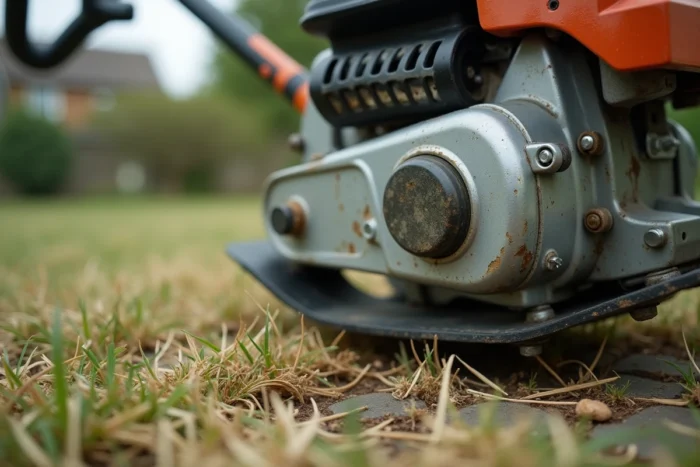
The majority of consumer gas brush cutters come with a 2-stroke engine. This type of engine runs on a gasoline-oil mixture, starts more easily in cold weather, and is lighter at equal displacement. The 4-stroke engine, on the other hand, separates oil and gasoline, produces less smoke, and consumes slightly less fuel.
However, the 4-stroke engine is heavier, and its mechanical maintenance (oil change, oil level) requires more regular monitoring. For a private garden used a few hours a month, the 2-stroke remains the most common choice because its maintenance is limited to the correct mixture and cleaning the air filter.
The Gasoline-Oil Mixture: A Frequent Source of Avoidable Breakdowns
An improperly dosed mixture can clog the engine or cause overheating. Manufacturers specify a precise ratio in the manual (often visible on the tank cap). Using a graduated measuring can costs a few euros and avoids most service visits related to the carburetor.
Another underestimated point: fuel that stagnates in the tank during winter degrades the seals and clogs the system. Emptying the tank before storage or using a fuel stabilizer significantly extends the engine’s lifespan.
Durable Gas Brush Cutter: Thinking in Terms of Repairability Rather Than Purchase Price
Classic guides compare models based on power and price. A less covered but crucial angle for individuals concerns the availability of spare parts and ease of repair. A brush cutter whose cutting head, starter, or air filter can be replaced without specific tools remains functional much longer than a compact model that is difficult to repair.
- Check that the manufacturer offers an online spare parts catalog with clear references by model.
- Prefer brands with a network of dealers or authorized service centers near you (Stihl, Echo, Husqvarna, for example).
- Examine the design of the air filter: a filter accessible without disassembling the casing can be cleaned in two minutes and prevents the gradual clogging of the carburetor.
- Look at whether the cutting head accepts universal string or only proprietary string, which affects the cost of use over several seasons.
Eco-design is gaining ground in the gardening tools sector. Treatment pathways for equipment are placing more emphasis on robustness and repairability. A model designed to last ten years costs less than a model replaced every three years, even if the initial purchase price is higher.

Harness, Handle, and Comfort: The Criteria That Matter After the First Hour
On a plot of a few hundred square meters, user comfort often takes a back seat during the purchase. After an hour of brush cutting on sloped or uneven terrain, the weight of the machine, the quality of the harness, and the type of handle become the primary factors of fatigue.
A handlebar-type handle (bike style) distributes the effort across both arms and is suitable for large flat areas. The loop handle, more compact, offers greater maneuverability in cluttered areas (around trees, along fences). The choice directly depends on the terrain configuration.
The Harness: An Accessory That Determines Session Duration
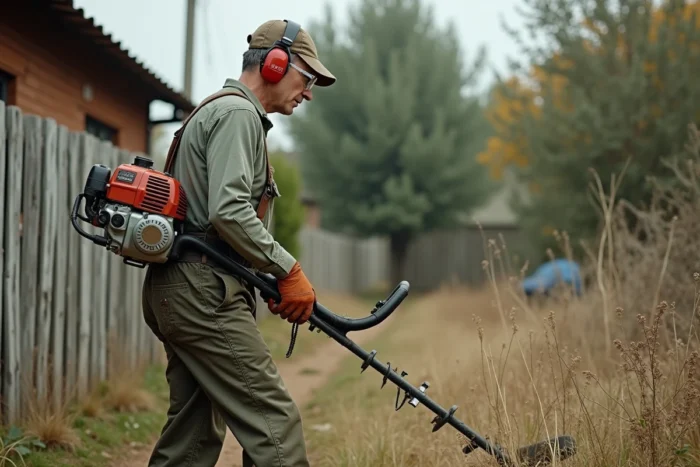
A forestry harness with double straps and a lumbar belt transfers weight to the hips rather than the shoulders. For use exceeding half an hour, this type of harness significantly reduces muscle fatigue. Some models include an anti-vibration system that dampens shocks transmitted to the back.
Recent feedback from regular users places the harness and the easy-start system among the most decisive criteria, sometimes even ahead of engine displacement. A powerful but uncomfortable machine ends up stored at the back of the garage.
The choice of a gas brush cutter benefits from being approached based on the actual terrain (level of overgrowth, surface area, slope) rather than just the technical sheet. The rigid transmission, a well-maintained 2-stroke engine, and a suitable harness form a more reliable set over time than a high-end model poorly matched to the intended use.