A poorly calibrated trendy accessory transforms a well-managed outfit into a costume. The problem never lies with the piece itself, but with its interaction with the rest of the silhouette. We observe this recurring mistake: accumulating strong pieces without visual hierarchy. The technical question that arises before any purchase is that of the unique focal point, the only element that the eye should catch first.
Trendy accessories and visual overload: the trap of multiple focal points
Each outfit supports a single center of attention. A micro-format bag in tinted resin, a sculptural brooch, and XXL earrings worn together cancel each other out. The external observer’s eye no longer knows where to settle, and the desired effect disappears in the visual noise.
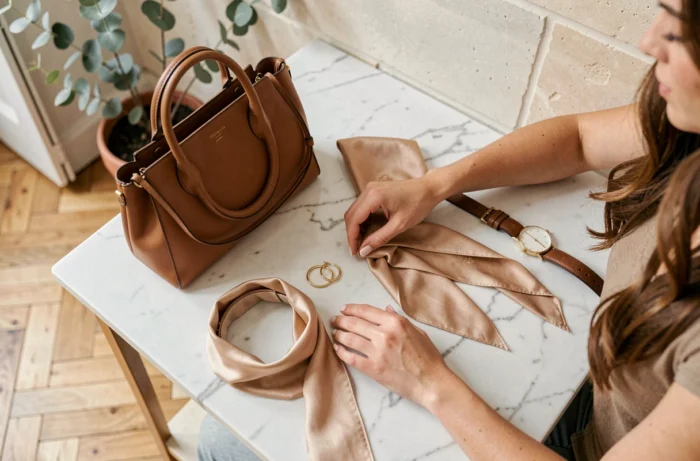
We recommend testing a simple method before going out: choose a neutral base in material and color, then add a single high-impact accessory. The rest of the elements (watch, ring, belt) should remain understated, in tones close to the garment.
The layering of accessories only works when the pieces share a coherence of material or palette. Stacking three tinted resin bracelets on one wrist creates a readable ensemble. Mixing a polished ceramic bracelet, a textured gold bangle, and a braided leather strap produces a muddle that even a monochrome base cannot salvage.
To explore pieces that work together without creating visual conflict, Camille Un Point C’est Tout’s selection of accessories brings together ranges designed in coordination of materials and finishes.
Sculptural brooches and micro-format bags: two trends that change the rules
Sculptural brooches are making a marked return on the spring-summer 2026 runways, with a presence at Chanel, Schiaparelli, and Dior. This is not a discreet accessory. A structured brooch replaces a statement necklace and is worn on a jacket lapel, a dress strap, or a shirt collar.
Placement matters as much as the piece. A brooch positioned too low on a blazer goes unnoticed. Too high, it draws the eye to the shoulder instead of the face. The optimal area is between the clavicle and the top of the chest, where the gaze naturally goes in conversation.
The micro-format bag as a stylistic constraint
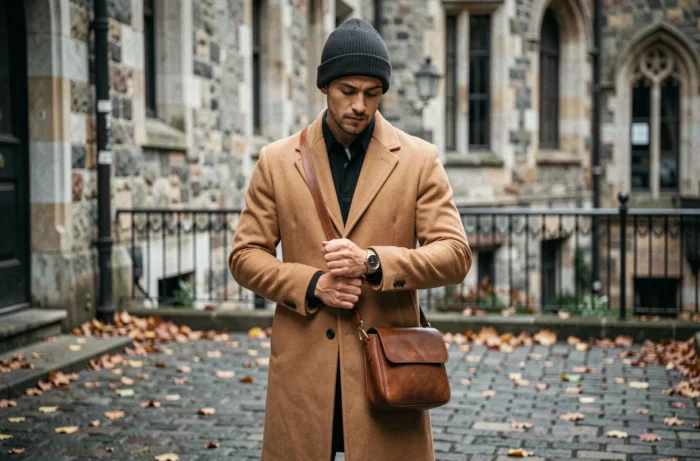
The micro-format bag dominates accessory trends in 2026. Its small size imposes a radical choice: it only carries the essentials, and visually, it lightens the silhouette instead of weighing it down.
Its true stylistic interest lies elsewhere. A bulky bag crushes a minimalist outfit. A micro-bag allows the outfit to breathe and functions as a point of color or texture rather than as a structuring element. It can be worn with a short strap to raise the waistline, or in hand for a more graphic effect.
Jewelry materials 2026: resin, ceramic, and textured gold in practice
This season’s trendy jewelry is distinguished by tactile materials that break away from the all-smooth metal of previous years. Three finishes structure the offering:
- Tinted resin: earth-inspired colors (ochre, terracotta, olive), worn in wide bracelets to stack on the same wrist. Works on a linen or raw cotton base.
- Polished ceramic: matte and smooth finish, often in earrings or pendants. Adds visual weight without metallic shine, ideal for dark outfits.
- Textured gold: hammered, twisted, or granulated surfaces that capture light unevenly. A single piece of textured gold is enough to structure a neutral look.
The classic trap is mixing these three materials in the same outfit. Each has a different visual language. Resin evokes nature and craftsmanship. Ceramic plays on contemporary sobriety. Textured gold adds a more dressed-up dimension. Combining them is like speaking three languages in the same sentence.
Belt and scarf: structural accessories rather than decorative ones
The belt is not an ornament. It is a tool for proportion. On a flowing dress or an oversized blazer, it redefines the waist and alters the reading of the silhouette. In smooth and thin leather, it remains discreet. In braided leather or with an elaborate buckle, it becomes the focal point, which implies reducing other accessories.
We observe that the belt works best when it contrasts with the texture of the garment. A grainy leather belt on a knit dress creates visual tension that adds depth to the whole. Leather on leather or fabric on fabric flattens the outfit.
The scarf as an adjustment variable
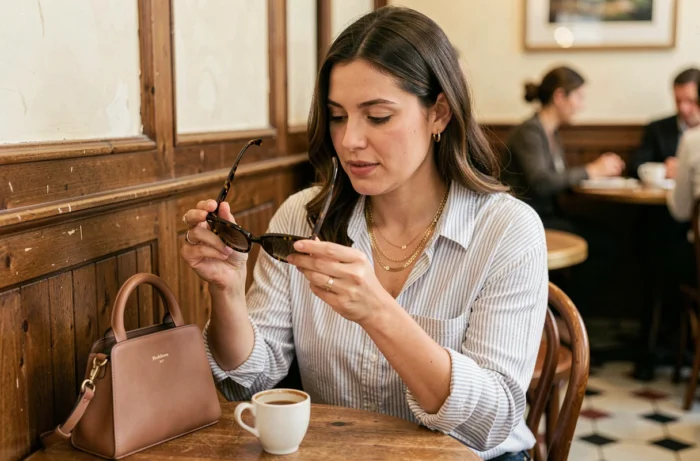
The scarf is the most versatile accessory in terms of placement. Tied around the neck, it frames the face. Attached to a bag handle, it adds color without touching the outfit. Worn in the hair, it replaces often overly marked head jewelry.
A patterned scarf (polka dots, geometric, floral) should not be worn with an already printed outfit, unless one of the two remains very discreet. The operational rule: only one visible print per outfit. The scarf is the last element added, never the first chosen.
- On a monochrome base: contrasting patterned scarf, tied short around the neck or as a headband
- On an already textured outfit (wrinkled linen, knit): solid scarf in a complementary tone
- In summer on a strap dress: thin scarf tied on one shoulder to break symmetry
Style is not built through accumulation but through subtraction. Each added accessory must justify its presence against what is already worn. When doubt arises in front of the mirror, removing a piece almost always yields a better result than adding one.