
Anastasia Kvitko has become one of the most recognizable faces in modeling on social media without ever going through the traditional agency circuit. Born in Russia, she built her fame on Instagram thanks to an atypical figure and a personal branding strategy that earned her the nickname “Russian Kim Kardashian.” Her journey illustrates a career model that bypasses the traditional gatekeepers of fashion.
Rejection of agencies and building an independent career
Before becoming a necessary figure on Instagram, Anastasia Kvitko knocked on the doors of modeling agencies that advised her to alter her body to fit industry standards. Rather than conforming to these demands, she chose to invest in her own channels.
This rejection is not anecdotal. It explains the entirety of her trajectory. She built her career without a traditional modeling agency, directly posting her glamorous shoots on Instagram from Miami, then Los Angeles.
To better understand the steps of this atypical journey, the Anastasia Kvitko page on Libereco outlines her complete biography, from her beginnings in Russia to her move to the United States.
Her move to the United States, first to Miami and then to Los Angeles around 2016, marks a turning point. She left Russia for a market where the influencer economy is already structured, with brands ready to collaborate directly with content creators.
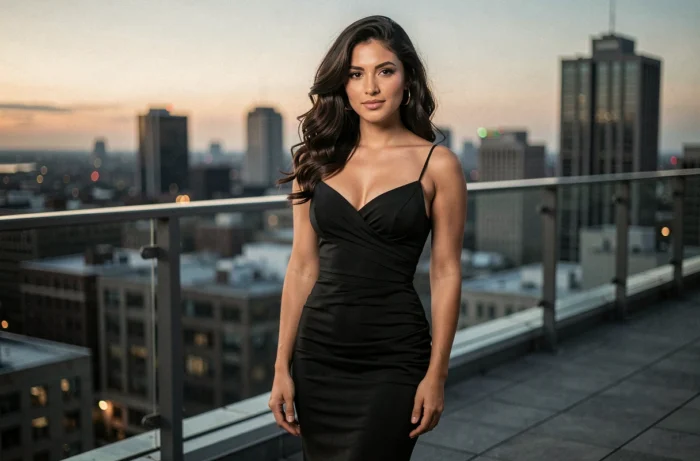
Anastasia Kvitko and personal branding on Instagram
Why has her Instagram account gained such prominence? The answer lies less in her measurements than in her method. Kvitko treated Instagram as a commercial showcase from the start, not just a photo album.
Where many influencers post spontaneously, she adopted a branding logic. Each post served a purpose: visibility, partnership, or product promotion (swimwear, sportswear, accessories).
A consistent visual strategy
Her content follows a recognizable editorial line. The settings (beaches, hotels, studios), poses, and visual treatment remain constant. This consistency allows partner brands to know exactly what they are buying.
The nickname “Russian Kim Kardashian,” attributed by the media, has acted as a popularity accelerator. Kvitko has even publicly embraced this comparison, claiming to rival the original in terms of physique.
Diversification of income
Her strategy has not been limited to sponsored posts. Several elements make up her business model:
- Partnerships with fashion and swimwear brands, negotiated directly without going through an intermediary agency
- Launching her own line of swimwear, capitalizing on her image as a glamorous model
- Premium and paid content aimed at a loyal audience, a trend increasingly common among influencers in this category
This hybrid model (modeling, entrepreneurship, direct content) distinguishes her from traditional models who depend on an agent or a fashion house.
From glamorous modeling to paid adult content
The recent evolution of Anastasia Kvitko reflects a broader trend in the creator economy. Several glamorous influencers have migrated to paid content platforms, where monetization is more direct and less dependent on Instagram’s algorithms.
This shift is not an accident. It responds to a simple economic logic: advertising revenues on Instagram fluctuate, while paid subscriptions offer more predictable income.
For Kvitko, this pivot is part of the continuity of her initial approach. From the beginning, she chose to maintain total control over her image and income. Premium content platforms only amplify this autonomy.

Anastasia Kvitko facing traditional modeling standards
Kvitko’s journey raises a concrete question about the fashion industry. Have you noticed that the most followed models on social media do not always meet the criteria of haute couture shows?
Kvitko has publicly stated that her appearance is natural, denying having undergone cosmetic surgery (except for an appendectomy). She refused to lose weight despite agencies’ recommendations, claiming to be satisfied with her body and its atypical measurements.
This stance has fueled her popularity as much as controversies. Traditional agencies value elongated silhouettes. Social media, on the other hand, rewards what generates engagement, regardless of industry norms.
A reproducible model?
The Kvitko case is often cited as an example of success outside the system. The reality is more nuanced:
- Her strategy relies on a highly codified physical exposure, which limits transposition to other fields
- Dependence on a single platform (Instagram) remains a risk, hence her diversification into other channels
- Personal branding does not replace an agency for haute couture contracts, but it opens other equally lucrative markets
Anastasia Kvitko has participated in a few audiovisual projects, including the show “Telemundo: Un nuevo Dia” in 2016 and productions like “Kon’ izabellovoy masti” in 2019 or “Prikosnovenie” in 2021. These incursions remain secondary compared to her main activity on social media.
Anastasia Kvitko’s journey illustrates a lasting shift in the modeling industry. Agencies are no longer a mandatory passage. Controlling one’s own image, combined with a consistent content strategy, can generate a viable career without ever walking down a runway.